
Intro to Astrology Crash Course
Updated: Apr 29
Astrology is a discipline derived from astronomy that involves generating and reading charts of the sky. These charts include representations of planets, asteroids, and mathematical points, as well as their interactions, to determine general characteristics of a person and their life. If that sounds like a lot,…. Well that’s because it is. I’ve been studying astrology for over seven years, and I still haven’t wrapped my mind around everything. Luckily, you don’t need to know it all to apply it to your life in a positive way—and I’m going to give you a quick rundown.

The first of these charts is a natal chart. A natal chart is a picture of the cosmos at the exact moment you were born, and it looks like the face of a clock. The rising sign—also known as the ascendant—is the starting point of the chart and symbolizes your spirit entering human form (yes, it gets deep).
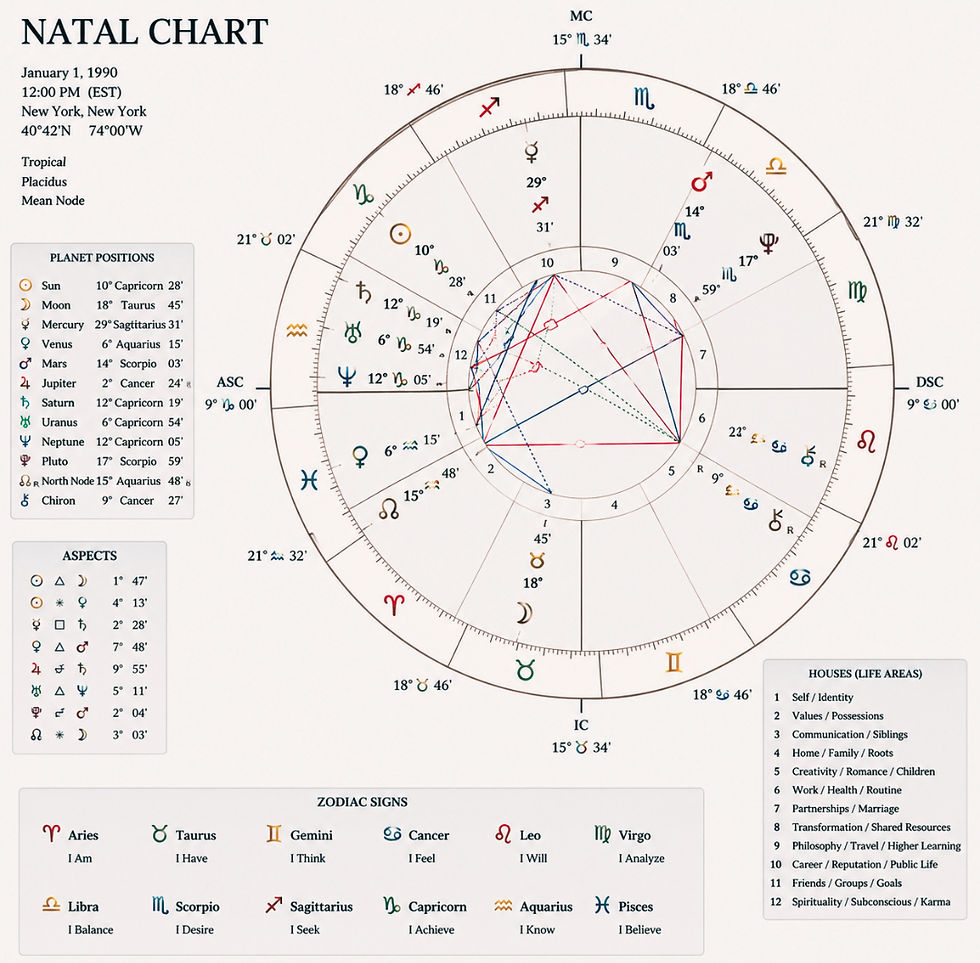
The ascendant is located at the 9:00 position. All planets, many asteroids, and key mathematical points are displayed on this chart, which is divided into 12 sections called houses. Each house represents a different area of life. The ascendant begins the first house, and the remaining houses continue counterclockwise around the chart.
In the diagram above, House descriptions are on the bottom right, subject information is on the top left, with planets and points below that, and aspects - which are planetary interations depicted by lines in the inner circle of the diagram. The horoscopes most people are familiar with are based on planetary movements within the houses.
The zodiac signs of your Sun, Moon, and Rising are commonly referred to as your “Big 3.” Together, they describe how you view, interact with, and intuitively experience the world. You can find all three on your natal chart. If you want to generate your own chart, I’ve included a link HERE. You’ll need your birth date, time, and location. The Sun and Moon represent the actual luminaries in the sky, while the Rising sign is calculated based on the sign on the horizon at the moment of your birth.
The ascendant represents your persona and how you interact with the external world. The Sun represents your ego and life purpose, while the Moon reflects your deep emotional needs and instincts.

As we know, the Sun, Moon, and planets are constantly moving. Similar to the Moon’s influence on ocean tides, astrology suggests that celestial bodies have energetic effects on Earth. Different charts can be used to analyze how current planetary movements interact with your natal chart and what opportunities these energies may present. The key is how you use them—alongside your free will—to set intentions and take action. Emphasis on free will.
Which brings me to the most important point: nothing in astrology is guaranteed.
Each planet, point, house, and zodiac sign carries numerous layers of symbolism that can manifest in different ways. No single transit determines a fixed outcome. Furthermore, we all have the free will to make independent decisions to live our lives the way we want to REGARDLESS of our race, religion, gender - and most of all - zodiac sign. The energies are available for all of us to use in our own unique ways and I encourage you to use astrology to align yourself with your higher purpose versus falling into the rabbit hole of trying to predict life using astrology. It’s a tool for self-awareness—not prediction.
That being said,
Alongside the natal chart, a transit chart is used to generate horoscopes. While the natal chart reflects the moment of your birth, a transit chart captures the current state of the cosmos. Because planetary positions are always changing, the energy is always shifting, which is why horoscopes are time-specific. The design of astrological charts can vary deposending on software or the preference of the user, but every chart should all display the houses, signs and planets at minimum. For example, the natal chart above is very detailed, whereas the transit chart below is more minimal. Feel free to click the planet icons to see additional inforation.
Your natal placements never move—they reflect who you are at your core. In the nature versus nurture debate, the natal chart represents nature, while transits represent nurture. Life experiences are only half the story—how you respond to them is the other half. In the above diagram, the subject is a Scorpio Sun, Scorpio Rising and Capricorn Moon.
For example, if you experience bullying, you can either internalize that behavior and become a bully, or rise above it and become an advocate. In astrology, this is often described as expressing the higher or lower vibration of an energy. That’s where he aforementioned free will comes in. Your natal char sets the stage, the transiting planets are characters, but only you can decide how you show up and perform.
Astrology won’t tell you exactly what will happen, but it can highlight potential themes and opportunities. At its best, it’s a tool for reflection. We move through life forming habits, biases, and patterns that keep us stable—but sometimes limited. Astrology helps bring awareness to those patterns and offers a new perspective on how we experience life.
For example, I’m a Pisces rising. The rising sign represents your personality, how you see the world, and the persona you generall show the world. The more I learned about Pisces and the function of the rising sign, the more I recognized my sensitivity, intuition, and emotional openness.
That doesn’t mean I’m this way because I’m a Pisces rising—but it gave me a framework to understand myself more clearly. It helped me become more aware of how I absorb other people’s energy and how to protect it.
I’m naturally empathetic and open with others. I could use that to manipulate people—but I choose not to. I choose to see the best in people, while still developing discernment. Understanding my chart helped me align my behavior with my values and move more intentionally in my relationships.
This is just one example of how astrology can be a powerful tool for self-reflection. Every planet, point, and house adds another layer of insight. No two charts are the same, and you can’t form a complete picture from your Sun sign alone.
If you’re interested in exploring your chart, there are several apps and websites that can generate a basic analysis. Once you have your placements, you can research them further. Just know that having your exact birth time is important for accuracy. Without it, you can still see your planetary signs—but not your rising sign or house placements.
Astrology, at its best, is a tool for questioning your own psychology. It helps you move beyond your biases and better understand your beliefs, your patterns, and your perspective. I hope you find this journey as insightful as I have.
If you’re already familiar with your natal chart, I’d love to hear how it changed your perspective on yourself in the comments below.
Resources for generating your Natal Chart.





Comments